
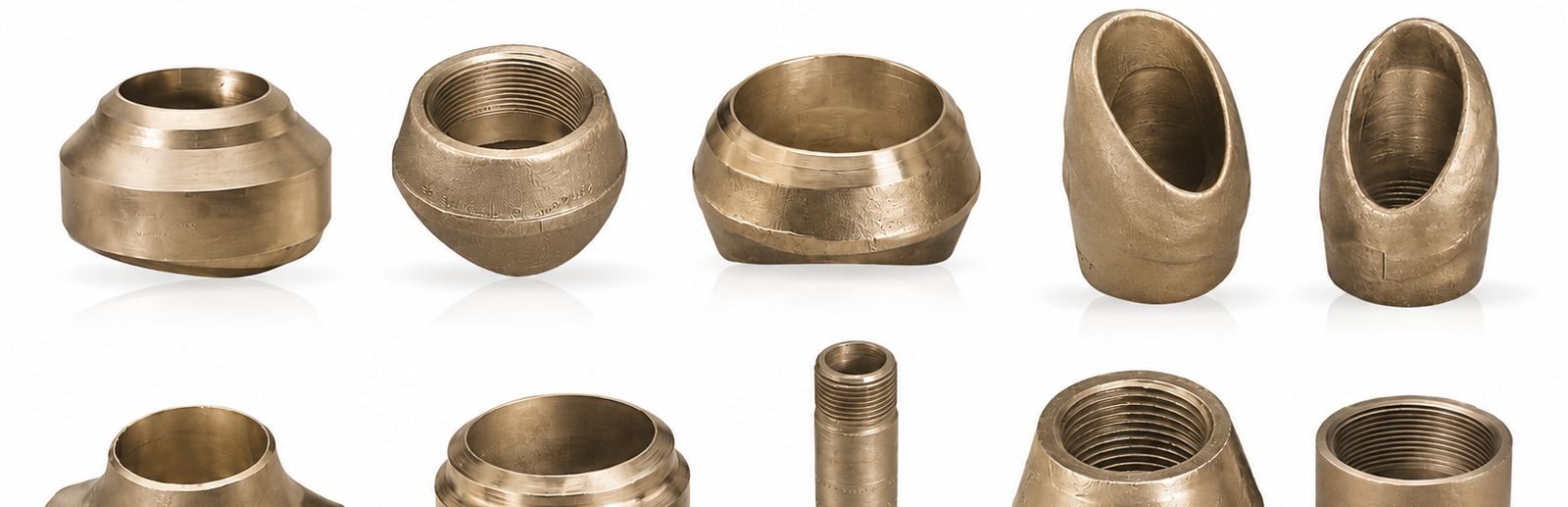
Branch outlet fittings solve a problem that fabricated branch connections handle poorly: taking a strong, code-compliant branch off a run pipe without the extra welding, reinforcing pads and inspection burden of a manually fabricated tee-and-pad assembly. Weldolet, sockolet and threadolet are the three most common outlet types, and each is built for a different connection method on the branch side.
Why Integral Reinforcement Matters
Cutting a hole in a run pipe for a branch connection removes material exactly where the pipe wall needs strength most — at the opening, where stress concentrates under internal pressure. Branch outlet fittings are forged with a heavier base section that fuses onto the run pipe, replacing the strength that a plain cut-and-weld branch would lose, without needing a separately welded reinforcing pad. That's the "integrally reinforced" part of their MSS SP-97 classification — the reinforcement is part of the forging, not an add-on.
Weldolet — Butt-Welded Branch Connections
A weldolet is butt-welded onto the run pipe and provides a butt-weld branch connection on the outlet side, making it the strongest and most permanent of the three outlet types. It's the default choice for larger branch sizes, high-pressure service, and anywhere the branch connection needs full weld-strength continuity with the run pipe — process piping, high-pressure cooling headers, and structural piping systems.
Sockolet — Socket-Welded Branch Connections
A sockolet welds onto the run pipe the same way a weldolet does, but provides a socket-weld connection on the branch side rather than a butt weld. That makes it the natural choice for smaller branch sizes where socket welding is already standard practice — matching the connection style used on the rest of a small-bore CuNi system, so installation crews aren't switching techniques mid-system.
Threadolet — Threaded Branch Connections
A threadolet again welds onto the run pipe, but offers a threaded (NPT/BSPT) connection for the branch. It's specified wherever the branch line itself needs to be threaded — instrumentation tie-ins, gauge connections, small utility branches — while still keeping the strong, integrally reinforced weld onto the main run.
Other Outlet Types Worth Knowing
- →Elbolet — for taking a branch connection directly off an elbow rather than a straight run, where geometry rules out a standard outlet.
- →Latrolet — a lateral (angled) outlet for branch connections that need to enter the run at other than 90°, common in gravity-drained or flow-directional systems.
- →Sweepolet — a full-encirclement, smoothly swept outlet used where high flow or high pressure make a sharp branch intersection undesirable.
- →Nipolet — combines an outlet base with an integral nipple, useful for compact instrument or drain connections.
Selecting the Right Outlet Type
The decision usually comes down to two questions: what connection method does the branch line need (butt weld, socket weld, or thread), and does the branch come off a straight run or an existing elbow? Match the outlet type to those two answers first, then size it against the run and branch NPS using the reinforcement data on your branch outlet fitting specification sheet — larger branch-to-run ratios typically call for a heavier-bodied outlet to maintain equivalent reinforcement.
In short: weldolet, sockolet and threadolet all solve the same reinforcement problem — they just differ in how the branch line connects. Choose based on the branch connection method you need, and let the integral forging do the reinforcement work a fabricated pad connection can't match.